Introduction
What is meant by the return of Christ?
In God’s plan of salvation for His people, He sent Jesus to earth to make atonement for their sins. This Jesus completed at His first coming. When this work was complete, He ascended to heaven and took His place at God’s right hand. When history is finished, Jesus will return again, not for salvation but for judgment.
Who is Jesus?
See here.
Where does the Bible teach this?
The author of Hebrews writes:
Otherwise, He would have needed to suffer often since the foundation of the world; but now once at the consummation of the ages He has been manifested to put away sin by the sacrifice of Himself. And inasmuch as it is appointed for men to die once and after this comes judgment, so Christ also, having been offered once to bear the sins of many, will appear a second time for salvation without reference to sin, to those who eagerly await Him. (Hebrews 9:26-28)
Here, the author teaches us that Jesus came the first time to deal with sin. He put it away by the sacrifice of Himself. The second time Jesus appears will be to gather up His people and to bring them into the new heaven and the new earth.
What does the Bible teach us about Christ’s second coming?
First, it will be personal. Christ as a real and recognizable person will return to earth. Paul says the Lord Himself will descend from heaven… (1 Thessalonians 4:16)
Second, Christ’s return will be literal and visible. Jesus told His disciples that His return to earth would be the same as His ascension to heaven. (Acts 1:11) John writes that we will see him. (1 John 3:2; Revelation 1:7)
Third, Christ’s coming will be unspeakably glorious with a loud and great display of God’s power. Jesus said that His coming would in His glory with all the angels accompanying. (Matthew 13:41-43; 25:31) He said that His coming would be with power and great glory. (Matthew 24:30) Paul says that a trumpet blast will sound. (1 Thessalonians 4:16)
Fourth, Christ’s coming will be soon. (Revelation 22:7, 12, 20)
Fifth, Christ’s coming will be a surprise. (Matthew 24:50) Paul and Peter both say that it will come like a thief in the night; i.e. when no one is expecting it. (1 Thessalonians 5:2; 2 Peter 3:10)
The Millennium
What is the millennium?
This is a 1000 year time period in which Christianity will flourish and spread throughout society.
Where does the Bible teach this?
The only place where there is an explicit reference to such a 1000 years is here:
Then I saw an angel coming down from heaven, holding the key of the abyss and a great chain in his hand. And he laid hold of the dragon, the serpent of old, who is the devil and Satan, and bound him for a thousand years; and he threw him into the abyss, and shut it and sealed it over him, so that he would not deceive the nations any longer, until the thousand years were completed; after these things he must be released for a short time. Then I saw thrones, and they sat on them, and judgment was given to them. And I saw the souls of those who had been beheaded because of their testimony of Jesus and because of the word of God, and those who had not worshiped the beast or his image, and had not received the mark on their forehead and on their hand; and they came to life and reigned with Christ for a thousand years. The rest of the dead did not come to life until the thousand years were completed. This is the first resurrection. Blessed and holy is the one who has a part in the first resurrection; over these the second death has no power, but they will be priests of God and of Christ and will reign with Him for a thousand years. (Revelation 20:1-6)
What is meant here by the abyss?
This is a place which leads to the bottomless pit. (Revelation 9:1) It is here that the dragon is imprisoned for 1000 years.
What is meant by Satan being imprisoned for 1000 years?
This means that the activity and success of Satan’s work will be greatly curtailed and restrained. The work of the gospel will go forth with much more success.
What disagreements are there amongst Christians on this point?
- what exactly is meant by the 1000 years;
- whether the second coming of Christ is before or after the millennium;
- the location of the thrones in Revelation 20:4;
- what kind of resurrection is referred to at the end of Revelation 20:4;
- the people who will be judged in Revelation 20:11-13;
- whether the judgment of the wicked and righteous will be at the same time or separated by 1000 years.
1000 Years
What is the disagreement on this point?
The precise point of disagreement here is whether this 1000 years is to be understood as a literal, 1000 years or as a symbol representing a long time period of time.
What reason is there for holding that this is anything but a reference to a literal 1000 years?
Because most of the book of Revelation is written in the apocalyptic genre. We do not expect numbers and objects in this kind of literature to be understood literally. In other forms of literature, our default understanding is that numbers are to be understood literally. In apocalyptic literature, however, we do just the opposite. We assume a number is a symbol of something and that it is not to be understood literally unless there are good reasons to the contrary.
What is the symbolism of the number 1000 here?
It is a symbol for completeness. In other words, when the time God has allotted for this part of His divine plan of salvation is complete, then He will move to the next part of His plan.
This sounds like a difference in hermeneutics.
Yes, that is precisely the issue. The dispensational scholars insist that prophecy be interpreted as literal speech. Other scholars teach that just because many prophecies do not have literal fulfillments, does not mean they remain unfulfilled.
What Old Testament prophecies were not fulfilled literally?
Consider Malachi’s prophecy:
Behold, I am going to send you Elijah the prophet before the coming of the great and terrible day of the LORD. (Malachi 4:5)
This was fulfilled by John the Baptizer (Matthew 11:13–14), not the actual person of Elijah.
We know the promise God gave to David that one of his descendants would always be sitting on his throne. Peter says that this was fulfilled in Jesus’ resurrection. (Acts 2:31)
Amos prophesied:
In that day I will raise up the fallen booth of David, And wall up its breaches; I will also raise up its ruins And rebuild it as in the days of old; 12 That they may possess the remnant of Edom And all the nations who are called by My name,” Declares the LORD who does this. (Amos 9:11-12)
At the council of Jerusalem, James quotes this and says that it was fulfilled in the gentile mission. These are not strictly literal fulfillments of prophecy, and yet the apostles view them as fulfillments all the same.
Pre- or post- millennial
What is the question here?
This is the question of whether the second coming or the return of Christ will be before the millennium or after.
What do the premillennialists teach?
Premillennialists teach that Christ will return to earth before He sets up His millennial kingdom. Thus, the name PRE-millennial to indicate that the second coming is before the millennium.
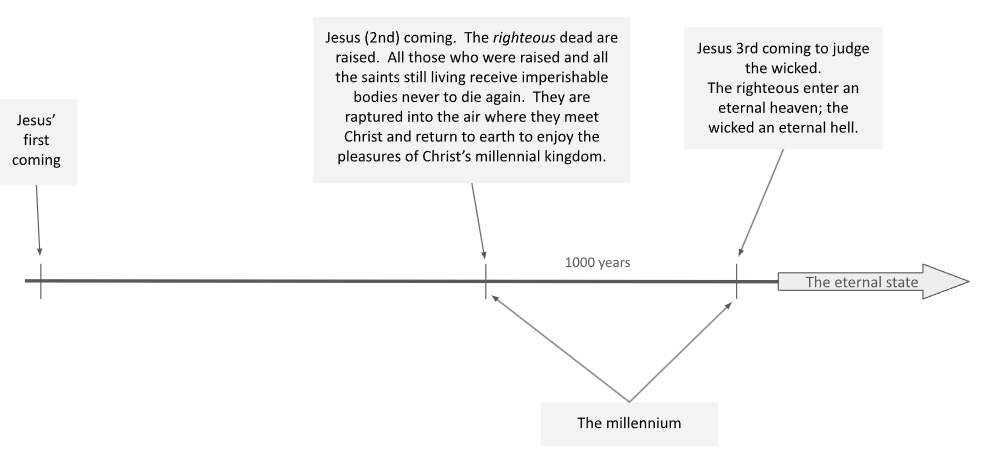
Explain this.
Premillennialists teach that Jesus will return to earth in great glory. God’s elect will be raised from the dead and will be ushered into the millennial age. Those believers who are alive at this time will be given immortal bodies and will also enter the millennium. The non-elect dead will remain in their graves during the time of the millennium. When the millennium is complete, the non-elect will be raised, will be judged, and will be cast into hell. The premillennial timeline looks like this:
- The Continued Progress of the Gospel and Rising Global Tribulation
- The Great Apostasy and Rise of the Antichrist
- The Great Tribulation (Persecution of the Church)
- The Single, Post-Tribulation Second Coming of Christ
- The First Resurrection (only Believers) and the Rapture
- The Defeat of the Antichrist and Binding of Satan
- The Millennial Kingdom (Literal 1,000-Year Reign of Christ on Earth)
- The Loosing of Satan and Final Rebellion at the End of the Millennium.
- The Second Resurrection and Great White Throne Judgment
- The Eternal State (The New Heavens and New Earth)
What do post-millennialists teach?
There is very little difference between the post-millennial view and what is called the amillennial view. Both of these teach that the second coming of Christ will be post or after the millennium.
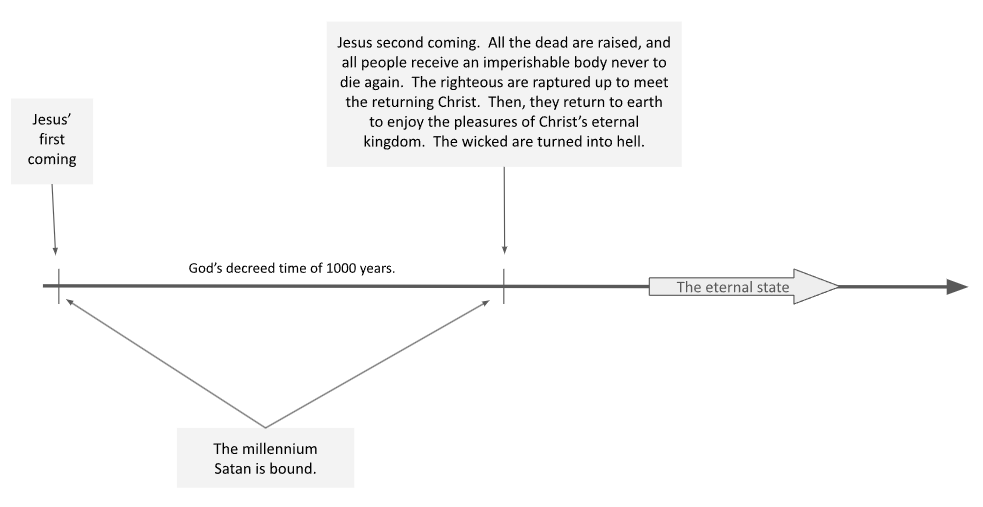
How do post-millennialists differ from amillennialists?
Post-millennialists teach that the millennium will be a period of great success for the gospel just prior to Christ’s return. Amillennialists teach that the millennium is all the time between the first and second comings of Christ. Most post-millennialists have since merged into the amillennialist camp.
What texts support the premillennial theory?
The only text which speaks explicitly of a millennium is Revelation 20. Here, we note:
- the millennium is explained in Revelation 20:1-6;
- the final judgment is explained in Revelation 20:11-13.
This implies that the return of Christ and the final judgment are after the millennium, not before.
How do premillennialists explain this text?
They note four things about Revelation 20:
Then I saw thrones, and they sat on them, and judgment was given to them. And I saw the souls of those who had been beheaded because of their testimony of Jesus and because of the word of God, and those who had not worshiped the beast or his image, and had not received the mark on their forehead and on their hand; and they came to life and reigned with Christ for a thousand years. (Revelation 20:4)
- These thrones are on earth, not in heaven;
- The resurrection is a return to physical life with a physical body on the earth;
- There is a 1000 year separation between the first and second resurrections;
- The judgment mentioned in Revelation 20:11-13 is the judgment of the unbelieving or wicked dead. The righteous dead were judged before the millennium.
The Thrones in Revelation 20
Why should we not think of these thrones as being on earth?
Bear in mind that both premillennial and amillennial Christians agree that those:
- who had been beheaded because of their testimony of Jesus and because of the word of God;
- who had not worshiped the beast or his image;
- who had not received the mark on their forehead and on their hand;
- who had come to life and reigned with Christ for a thousand years;
are the ones now sitting on these thrones. The only difference is that premillennialists understand these thrones to be on earth where the saints are living and reigning with Christ during the millennium.
The reason given for understanding these thrones to be in heaven is that thrones in the book of Revelation are almost always in heaven. Leon Morris notes (see his commentary on this verse) that John uses the word throne forty-seven times in Revelation; and except for Satan’s throne (Revelation 2:13) and that of the beast (Revelation 13:2; 16:10), all are in heaven.
The Resurrection of Revelation 20
What about the resurrection mentioned at the end of v4?
If the thrones are in heaven, then this resurrection is not to life with a physical body on earth but a resurrection to life in heaven where these martyred saints will live and reign with Christ for a millennium. It’s the same kind of life Jesus spoke of when he said that the patriarchs were still living. (Luke 20:37-38)
The People Judged in Revelation 20
Which people are being judged in Revelation 20:11-13?
The premillennialist is required to hold that only the wicked dead are judged in this judgment because he believes that the resurrection mentioned in Revelation 20:4 is the resurrection of the righteous dead:
Then I saw a great white throne and Him who sat upon it, from whose presence earth and heaven fled away, and no place was found for them. And I saw the dead, the great and the small, standing before the throne, and books were opened; and another book was opened, which is the book of life; and the dead were judged from the things which were written in the books, according to their deeds. And the sea gave up the dead which were in it, and death and Hades gave up the dead which were in them; and they were judged, every one of them according to their deeds. Then death and Hades were thrown into the lake of fire. This is the second death, the lake of fire. And if anyone’s name was not found written in the book of life, he was thrown into the lake of fire. (Revelation 20:11-15)
Why can’t this be the judgment of only those who died as unbelievers?
First, because this judgment involves all the dead:
- What reason can be given why the dead, the great and the small, standing before the throne should be understood as only the wicked dead?
- Furthermore, John writes And the sea gave up the dead which were in it. Did the sea only give up its non-elect dead? Were there no righteous persons who died at sea?
- John goes on to say that death and Hades gave up the dead which were in them. Are we to think that only wicked people were in hades? The word hades refers to the realm of the dead (see Seiss p272) where both the righteous and wicked go after death.
- What is the point of searching the Lamb’s book of life if everyone being judged is already known to be wicked? We may assume that some of the names of those judged are found in the Lamb’s book of life while others are not, and these are thrown into the lake of fire.
Second, Jesus says the judgment of the righteous and the wicked is in the same hour:
Do not marvel at this; for an hour is coming, in which all who are in the tombs will hear His voice, and will come forth; those who did the good deeds to a resurrection of life, those who committed the evil deeds to a resurrection of judgment. (John 5:28-29)
The prophet Daniel implies the same thing:
Now at that time Michael, the great prince who stands guard over the sons of your people, will arise. And there will be a time of distress such as never occurred since there was a nation until that time; and at that time your people, everyone who is found written in the book, will be rescued. Many of those who sleep in the dust of the ground will awake, these to everlasting life, but the others to disgrace and everlasting contempt. Those who have insight will shine brightly like the brightness of the expanse of heaven, and those who lead the many to righteousness, like the stars forever and ever. (Daniel 12:1-3)
What does John mean then, when he speaks of the first resurrection?
John uses this expression in Revelation 20:5. The first resurrection is when the martyrs are given life in heaven to live and reign with Christ while they wait for Christ’s return to earth. The rest of the dead (Revelation 20:5), both the righteous and the wicked, will be raised at the end of the millennium and judged then.
Sum this all up for me.
Let’s return to Revelation 20 again. The premillennialist reads it this way:
Then I saw thrones [on earth], and they [all the recently resurrected believers] sat on them, and judgment was given to them. And I saw the souls of those who had been beheaded because of their testimony of Jesus and because of the word of God, and those who had not worshiped the beast or his image, and had not received the mark on their forehead and on their hand; and they [died on earth but] came to life [on earth and received physical bodies again] and reigned with Christ for a thousand years [on earth along with all the other believers]. The rest of the dead [all those who died as unbelievers] did not come to life until the thousand years [the millennium] were completed. This [resurrection of the righteous dead] is the first resurrection [and takes place before the millennium]. Blessed and holy is the one who has a part in the first resurrection; over these the second death [hell] has no power, but they will be priests of God and of Christ and will reign with Him [on earth] for a [literal] thousand years. (Revelation 20:4-6)
The amillennialist reads it this way:
Then I saw thrones [in heaven], and they [the martyrs] sat on them, and judgment was given to them. And I saw the souls of those who had been beheaded because of their testimony of Jesus and because of the word of God, and those who had not worshiped the beast or his image, and had not received the mark on their forehead and on their hand; and they [died on earth but] came to life [in heaven] and reigned with Christ [in heaven] for a thousand years [in heaven]. The rest of the dead [both righteous and wicked] did not come to life [and receive their physical bodies back] until the thousand years [the millennium] were completed. This [resurrection of the martyrs] is the first resurrection. Blessed and holy is the one who has a part in the first resurrection; over these the second death [hell] has no power, but they will be priests of God and of Christ and will reign with Him [in heaven] for a thousand years. (Revelation 20:4-6)
What is the weakness of the amillennial doctrine?
The weakness of the amillennial doctrine is in its explanation of Revelation 20:5.
The rest of the dead did not come to life until the thousand years were completed. This is the first resurrection. (Revelation 20:5)
The amillennial reading implies that the martyrs remain in heaven living and reigning with Christ while those who did not die as martyrs receive their bodies back and enter into the new heaven and new earth. Amillennialists answer this by teaching that when Christ returns, He brings back with Him all the souls of those who are in heaven, including the martyrs. (1 Thessalonians 3:13; Jude 14)
Are there no other texts that speak about the millennium other than Revelation 20?
There is no other explicit reference. Some premillennialists point to certain Old Testament prophecies which they say will be fulfilled in the millennium:
Then a shoot will spring from the stem of Jesse, And a branch from his roots will bear fruit. 2 The Spirit of the LORD will rest on Him, The spirit of wisdom and understanding, The spirit of counsel and strength, The spirit of knowledge and the fear of the LORD. 3 And He will delight in the fear of the LORD, And He will not judge by what His eyes see, Nor make a decision by what His ears hear; 4 But with righteousness He will judge the poor, And decide with fairness for the afflicted of the earth; And He will strike the earth with the rod of His mouth, And with the breath of His lips He will slay the wicked. 5 Also righteousness will be the belt about His loins, And faithfulness the belt about His waist. 6 And the wolf will dwell with the lamb, And the leopard will lie down with the young goat, And the calf and the young lion and the fatling together; And a little boy will lead them. 7 Also the cow and the bear will graze, Their young will lie down together, And the lion will eat straw like the ox. 8 The nursing child will play by the hole of the cobra, And the weaned child will put his hand on the viper’s den. 9 They will not hurt or destroy in all My holy mountain, For the earth will be full of the knowledge of the LORD As the waters cover the sea. 10 Then in that day the nations will resort to the root of Jesse, Who will stand as a signal for the peoples; And His resting place will be glorious. (Isaiah 11:1-10)
What is the problem with the premillennial reading of this prophecy?
Some of this text doesn’t fit well with the premillennial understanding of what the millennium is. For example, Isaiah says that God will slay the wicked and that the earth will be full of the knowledge of the LORD as the waters cover the sea. But premillennial teaching says that the wicked and unbelieving will remain in the millennium; and in fact, will mount a massive attack on Christ at the close of the millennium.
What other texts support the premillennial understanding?
Premillennialists will often point to Isaiah’s teaching that there will be death in the millennium. (Isaiah 65:20)
How do amillennialists explain this text?
The text is not referring to the millennium but to the new heavens and the new earth. Consider the context:
For behold, I create new heavens and a new earth; and the former things will not be remembered or come to mind. But be glad and rejoice forever in what I create; for behold, I create Jerusalem for rejoicing and her people for gladness. I will also rejoice in Jerusalem and be glad in My people; and there will no longer be heard in her the voice of weeping and the sound of crying. No longer will there be in it an infant who lives but a few]days, or an old man who does not live out his days; for the youth will die at the age of one hundred and the one who does not reach the age of one hundred will be thought accursed. They will build houses and inhabit them; They will also plant vineyards and eat their fruit. (Isaiah 65:17-21)
The reference here to death is not to be understood literally but as a poetic way of referring to the future in idealistic terms. The prophets often describe the future in terms and pictures that come from their own experience. Motyer comments on this verse:
Throughout this passage Isaiah uses aspects of what we know to create impressions of what is to come—e.g. a life totally provided for (Isaiah 65:13), happy (Isaiah 65:19), secure (Isaiah 65:22–23), at peace (Isaiah 65:24–25). What we have no capacity to understand can be grasped only through what we know. In this present order, death cuts life off. Not so in the new Jerusalem: no infant will fail to come to maturity, nor the elderly be foiled of fulfilment. It is not meant to suggest that death will still be present. This would contradict for ever (Isaiah 65:18), no more (Isaiah 65:19) and the death of death in Isaiah 25:7–8. It simply affirms that, over the whole of life, the power of death will be gone. The only exception is that (lit.) ‘the sinner, a hundred years old, will be accursed’ (Isaiah 65:20). There will, of course, be no sinners in the new Jerusalem (Isaiah 65:6–7, 12, 15). We are again dealing with metaphor: even if, per impossibile, a sinner were to escape detection for a century, the curse would still search him out and destroy him. In reality, just as death will have no more power, so sin too will have no more place.
Furthermore, John references this verse (Revelation 21:1–4) and says that, in this time period, death will be no more.
What other texts do premillennialists use to support their doctrine of the millennium?
They point to the events given in Zechariah 14 as taking place during the millennial reign of Christ. That these verses are speaking of the millennium is clear because Christ is ruler over all the earth and there are those who will be punished by withholding rain. (Zechariah 14:17-19) This cannot possibly be a reference to the eternal state where everything is completely perfect.
What about Ezekiel’s temple? Is this not a reference to the millennial age?
The premillennialist argues very simply that since such a temple has never been built, it must still be future. We are also taught that there is no temple in the eternal state (Revelation 21:22); therefore, this temple must belong to the millennial age.
How should we understand Ezekiel’s temple?
First, we must grasp this principle of interpreting prophecy which was alluded to earlier. The prophets describe the future in symbols and metaphors taken from their own experience. Fairbairn writes (p136):
And even in the kind of imagery selected [by the prophets], it is but reasonable to infer that the same respect would be had to the ordinary laws of human thought, and that the images would be found in objects of the past or present, familiar to the individual; since thus alone could they either have presented themselves in a natural manner to the prophet’s imagination, or have been adapted to the apprehension of those for whom more immediately the revelations were imparted. It is only by things known, however relatively imperfect, that the mind can picture to itself such as are unknown; and in foreshadowing things that are yet to be, it must avail itself of those which have already been. In any other way to have conveyed to the prophets an insight into the coming issues of Providence, would have required not a supernatural working merely upon the human faculties, but the superaddition to them of a new sense, or the coercion of an irrational force.
Ezekiel was a priest, and therefore, we are not surprised to see him describe the future in terms of a magnificent temple explained in great detail.
Dispensationalism
What do the dispensationalists teach?
This is a more complicated version of the premillennial theory. It was the teaching of John Nelson Darby who was the founder of the dispensational school. He taught that Jesus would immediately and secretly rapture his people into the air and bring them to heaven. God’s people who had died would be resurrected and those still living would be snatched away to heaven in a single moment. This would then launch a seven year tribulation period in which the antichrist would arise and persecute the church terribly. At the end of this seven year tribulation, Jesus would come publicly and with great glory, defeat the antichrist at Armageddon, and bring all His people into the millennium. In a word, Darby understood the end times schedule this way:
- The Completion of the Church Age;
- The Pretribulation Rapture;
- The Rise of the Antichrist;
- The Great, Seven Year Tribulation (70th Week of Daniel);
- The Battle of Armageddon;
- The Second Coming of Christ;
- The Judgment of the Nations (sheep & goats);
- The Millennial (1000 year) Kingdom;
- The Final Rebellion & the Great White Throne Judgment;
- The Eternal State (New Heavens and New Earth).
This is also the understanding of the authors of the Left Behind series of novels.
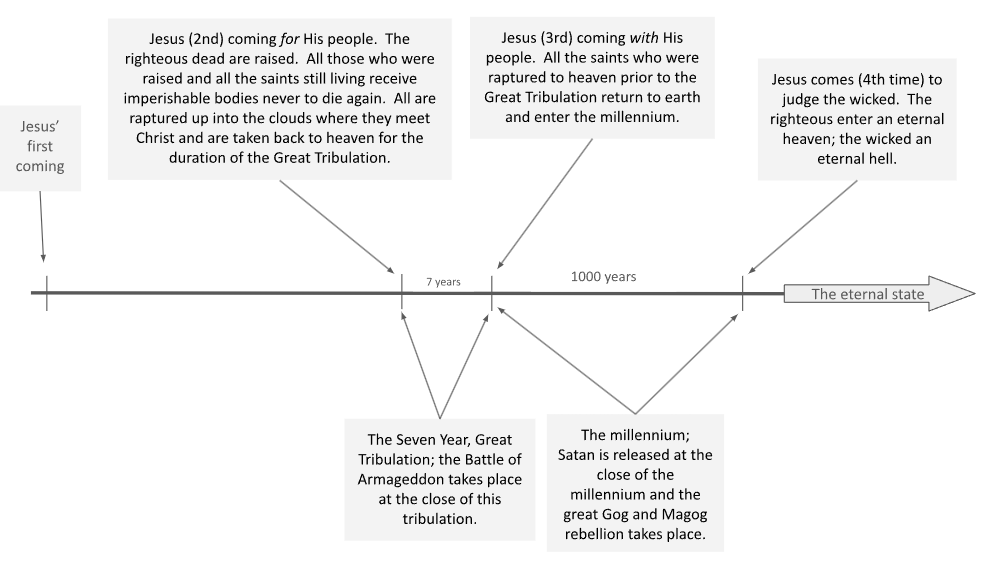
What are the problems with this theory?
Much of this has no biblical basis at all, and some of it flatly contradicts the Bible’s teaching. A seven year tribulation period is taught nowhere in Scripture. Darby often distinguished events that in the Bible are not so distinguished such as the sheep & goat judgment and the Great White Throne judgment.
Say more about this.
Consider #2. The Bible teaches that believers will go through the tribulation, not be raptured out of it. Paul writes to the Thessalonians:
Now we request you, brethren, with regard to the coming of our Lord Jesus Christ and our gathering together to Him, that you not be quickly shaken from your composure or be disturbed either by a spirit or a message or a letter as if from us, to the effect that the day of the Lord has come. Let no one in any way deceive you, for it will not come unless the apostasy comes first, and the man of lawlessness is revealed, the son of destruction, who opposes and exalts himself above every so-called god or object of worship, so that he takes his seat in the temple of God, displaying himself as being God. (2 Thessalonians 2:1-4)
Note that the great apostasy and the appearance of the man of lawlessness or the antichrist come before the day of the Lord or the return of Christ. This implies that the Great Tribulation will be before the coming of Christ, not after it and that believers will not be removed from it. Furthermore, John writes about the saints being overcome and even beheaded in the tribulation which implies that they went through it:
- It was also given to him to make war with the saints and to overcome them, and authority over every tribe and people and tongue and nation was given to him. (Revelation 13:7)
- Then I saw thrones, and they sat on them, and judgment was given to them. And I saw the souls of those who had been beheaded because of their testimony of Jesus and because of the word of God, and those who had not worshiped the beast or his image, and had not received the mark on their forehead and on their hand; and they came to life and reigned with Christ for a thousand years. (Revelation 20:4)
Jesus gives us God’s standard procedure: I do not ask You to take them out of the world, but to keep them from the evil one. (John 17:15)
How do dispensational scholars defend the idea that believers will not pass through the tribulation?
They point to Paul’s teaching where he assures them of God’s promise to spare them the anguish of the Great Tribulation.
For the word of the Lord has sounded forth from you, not only in Macedonia and Achaia, but also in every place your faith toward God has gone forth, so that we have no need to say anything. For they themselves report about us what kind of a reception we had with you, and how you turned to God from idols to serve a living and true God, and to wait for His Son from heaven, whom He raised from the dead, that is Jesus, who rescues us from the wrath to come. (1 Thessalonians 1:8-10)
Here Paul speaks of God’s promise to rescue His people from the wrath to come. And again, Paul speaks of God not having destined us for wrath:
But since we are of the day, let us be sober, having put on the breastplate of faith and love, and as a helmet, the hope of salvation. For God has not destined us for wrath, but for obtaining salvation through our Lord Jesus Christ, who died for us, so that whether we are awake or asleep, we will live together with Him. Therefore encourage one another and build up one another, just as you also are doing. (1 Thessalonians 5:8-11)
The “wrath to come” here is not a reference to the Great Tribulation but to eternal punishment.
Do the dispensational teachers hold that the antichrist will appear after the return of Christ in the time of the seven year tribulation?
Yes, Paul, however, teaches in 2 Thessalonians 2:3 that the man of lawlessness or the antichrist will come before the return of Christ.
The Great Tribulation
Why do dispensationalists speak of a seven year tribulation?
This doctrine rests entirely on their interpretation of Daniel’s prophecy of seventy weeks. There is no other biblical support for it. Walvoord writes, “The interpretation of this passage inevitably colors all other prophetic views, and a proper understanding of it is the sine qua non of any student of prophecy. “Is the Seventieth Week of Daniel Future?,” Bibliotheca Sacra 101 (1944): 30.
He gave me instruction and talked with me and said, “O Daniel, I have now come forth to give you insight with understanding. At the beginning of your supplications the command was issued, and I have come to tell you, for you are highly esteemed; so give heed to the message and gain understanding of the vision.
Seventy weeks have been decreed for your people and your holy city, to finish the transgression, to make an end of sin, to make atonement for iniquity, to bring in everlasting righteousness, to seal up vision and prophecy and to anoint the most holy place. So you are to know and discern that from the issuing of a decree to restore and rebuild Jerusalem until Messiah the Prince there will be seven weeks and sixty-two weeks; it will be built again, with plaza and moat, even in times of distress. Then after the sixty-two weeks the Messiah will be cut off and have nothing, and the people of the prince who is to come will destroy the city and the sanctuary. And its end will come with a flood; even to the end there will be war; desolations are determined. And he will make a firm covenant with the many for one week, but in the middle of the week he will put a stop to sacrifice and grain offering; and on the wing of abominations will come one who makes desolate, even until a complete destruction, one that is decreed, is poured out on the one who makes desolate. (Daniel 9:22-27)
What is meant here by weeks?
The word in Hebrew is just שָׁבֻעִים שִׁבְעִים which is translated a heptad of seventies. A heptad is a word used here to refer to a unit of seven just as a dozen refers to twelve of something.
What is the significance of these numbers?
The Jewish calendar cycled around the number 7.
- every 7th day was a sabbath;
- 7 weeks from Passover (in the first month) was Pentecost (Leviticus 23:15);
- every 7th month was a sabbath month with the fall feasts (Leviticus 23:24);
- every 7th year was a sabbath year for the land (Leviticus 25:3-4);
- every 7th sabbath year was a jubilee year. (Leviticus 25:8-9)
The numbers God uses in response to Daniel’s prayer are His way of signaling to His people that a great Jubilee Year is going to come.
Say more about Daniel’s prayer.
In the first part of Daniel 9, we have Daniel’s prayer where he pours out his heart for the restoration of Jerusalem. We are told that Daniel’s prayer is motivated in part by his recall of Jeremiah’s prophecy that Israel’s exile would last seventy years. (Jeremiah 25:11-12; 29:10) In Daniel 9:20-27, the angel Gabriel comes to Daniel and gives him God’s answer.
What decree is Daniel referring to when he writes, …you are to know and discern that from the issuing of a decree to restore and rebuild Jerusalem…?
Most dispensational scholars, understand this to be the decree of Artaxerxes spoken of in Nehemiah 2:1-8 when he allowed Nehemiah to return to Jerusalem to rebuild it. Owen also sees (p347) no other possible way to arrive at 490 years unless this is the decree mentioned here. Others object to this pointing out that Daniel’s prayer was motivated by Jeremiah’s prophecy. (Daniel 9:2) When we turn to the Chronicles, we find the same reference to Jeremiah’s prophecy:
Now in the first year of Cyrus king of Persia–in order to fulfill the word of the LORD by the mouth of Jeremiah–the LORD stirred up the spirit of Cyrus king of Persia, so that he sent a proclamation throughout his kingdom, and also put it in writing, saying, “Thus says Cyrus king of Persia, ‘The LORD, the God of heaven, has given me all the kingdoms of the earth, and He has appointed me to build Him a house in Jerusalem, which is in Judah. Whoever there is among you of all His people, may the LORD his God be with him, and let him go up!'” (2 Chronicles 36:22-23)
This lends itself to the idea that the decree mentioned by Daniel here was not Artaxerxes’ decree but Cyrus’ decree.
What other evidence is there that the decree here is Cyrus’ decree?
Consider the timeline. Babylon fell in 538bc to Cyrus. Daniel makes his prayer in the first year of Darius (Daniel 9:1) which would be 538bc. Cyrus makes his proclamation in roughly 538/537bc that the Jews can return. In 536, the first group of Jews, led by Zerubbabel arrive in Jerusalem. In this historical context then, “the decree” can only refer to what Cyrus proclaimed.
But if the decree is Cyrus’, then the numbers don’t add up correctly.
The intent of these numbers is not to give us a timeline or a countdown of events. The numbers are meant to point to the jubilee year and all that it implies.
The purpose of these seventy weeks is said to be …to finish the transgression, to make an end of sin, to make atonement for iniquity, to bring in everlasting righteousness, to seal up vision and prophecy and to anoint the most holy place. What does this mean?
The first three of these expressions:
- to finish the transgression,
- to make an end of sin,
- to make atonement for iniquity
are all synonymous expressions referring to the forgiveness of Israel’s sin. The expression “to bring in an everlasting righteousness” refers to Israel obeying God in a way that He accepts. Sealing up the vision and prophecy means that the Old Testament prophecies will be fulfilled. The anointing of the holy place means that a new temple will be established.
Daniel appears to teach here that the Messiah will come to an end.
Yes, the words Then after the sixty-two weeks the Messiah will be cut off and have nothing are often misunderstood. They are a reference to the crucifixion of Jesus but the last words should be translated, “…not for Himself.” See here.
Are the following words a reference to the destruction of Jerusalem in 70ad …and the people of the prince who is to come will destroy the city and the sanctuary. And its end will come with a flood; even to the end there will be war; desolations are determined?
Yes.
Who is the prince referenced in these verses?
The dispensational teachers teach the following:
So you are to know and discern that from the issuing of a decree to restore and rebuild Jerusalem until Messiah the Prince [the Messiah, Jesus] there will be seven weeks and sixty-two weeks; it will be built again, with plaza and moat, even in times of distress. Then after the sixty-two weeks the Messiah [the Messiah, Jesus] will be cut off and have nothing, and the people [the Roman army] of the prince who is to come [the antichrist] will destroy the city and the sanctuary [the destruction of Jerusalem in 70ad]. And its [Jerusalem’s] end will come with a flood; even to the end there will be war; desolations are determined. And he [the antichrist] will make a firm covenant with the many [with Israel] for one week, but in the middle of the week he [the antichrist] will put a stop to sacrifice and grain offering; and on the wing of abominations will come one [the antichrist] who makes desolate, even until a complete destruction, one that is decreed, is poured out on the one [the antichrist] who makes desolate. (Daniel 9:25-27)
Others understand this text this way:
So you are to know and discern that from the issuing of a decree to restore and rebuild Jerusalem until Messiah the Prince [the Messiah, Jesus] there will be seven weeks and sixty-two weeks; it will be built again, with plaza and moat, even in times of distress. Then after the sixty-two weeks the Messiah [Jesus] will be cut off and have nothing, and the people [the Roman army] of the prince who is to come [Titus] will destroy the city and the sanctuary [the destruction of Jerusalem in 70ad]. And its [Jerusalem’s] end will come with a flood; even to the end there will be war; desolations are determined. And he [Jesus] will make a firm covenant with the many for one week, but in the middle of the week he [Jesus] will put a stop to sacrifice and grain offering; and on the wing of abominations will come one [Titus] who makes desolate, even until a complete destruction, one that is decreed, is poured out on the one [Satan] who makes desolate. (Daniel 9:25-27)
Titus being the Roman general.
Matthew 24
Do premillennialists understand Matthew 24 to be speaking of the Great Tribulation?
Classical or historical premillennialists do not. Dispensational premillennialists do understand the passage this way.
Why can’t this passage be a reference to a seven year period just prior to the millennium?
Because Jesus clearly places the events He describes as within the lifetime of His audience:
Now learn the parable from the fig tree: when its branch has already become tender and puts forth its leaves, you know that summer is near; so, you too, when you see all these things, recognize that He is near, right at the door. Truly I say to you, this generation will not pass away until all these things take place. Heaven and earth will pass away, but My words will not pass away. (Matthew 24:32-35)
Whitby writes (p202):
These words, ἡ γενεὰ αὕτη, “this age or generation shall not pass away,” afford a full demonstration that all which Christ had mentioned hitherto was to be accomplished, not at the time of the conversion of the Jews or at the final day of judgment, but in that very age, or whilst some of that generation of men lived; for γενεὰ αὕτη, “this generation,” never bears any other sense in the New Testament than the men of this age. So Matthew 21:16, “To whom shall I liken γενεὰν ταύτην, the men of this age?” Matthew 12:42, “The queen of the south shall rise up in judgment μετὰ γενεᾶς ταύτης, with the men of this age;” and Matthew 12:45, “So shall it be τῇ γενεᾷ ταύτῃ τῇ πονηρᾷ, with the wicked of this age.” Matthew 23:36, “All these things shall come ἐπὶ τὴν γενεὰν ταύτην, upon the men of this age.” Mark 8:12, “τί ἡ γενεὰ ταύτη, Why do the men of this age seek a sign? No sign shall be given τῇ γενεᾷ ταύτῃ, to the men of this age.” Luke 7:31, “To whom shall I liken the men τῆς γενεᾶς ταύτης, of this age?” Luke 11:29, “The Son of man shall be a sign τῇ γενεᾷ ταύτῃ, to the men of this age;” so again Luke 11:30, 32, 50, 51; 16:8; and Acts 2:40, “Save yourselves ἀπὸ γενεᾶς τῆς σκολιᾶς ταύτης, from this froward generation.”
Therefore, we conclude that the events of Matthew 24 were fulfilled in the destruction of Jerusalem 70ad.
What are these events of which Jesus speaks in this chapter?
Jesus’ teaching in this passage is regarding the events of which the disciples asked him. Here’s what happened:
Jesus came out from the temple and was going away when His disciples came up to point out the temple buildings to Him. And He said to them, “Do you not see all these things? Truly I say to you, not one stone here will be left upon another, which will not be torn down.” As He was sitting on the Mount of Olives, the disciples came to Him privately, saying, “Tell us, when will these things happen, and what will be the sign of Your coming, and of the end of the age?” (Matthew 24:1-3)
Jesus’ tells the disciples that the temple and the city of Jerusalem will be utterly smashed to pieces. Naturally, the disciples want to know when these things will take place. Jesus responds by dividing their question into two. First, He addresses the destruction of Jerusalem; second, He answers the question about His return at the end of history.
Did the disciples actually ask two questions?
It’s not clear. Some have suggested that the sign of Your coming was a question pertaining to the destruction of Jerusalem and the question pertaining to the end of the age was about Jesus return. This is not certain, however.
How does Jesus answer these questions?
First, Jesus does not explicitly say that His answer pertains to two separate and distinct events. This makes it somewhat difficult to know where He stops speaking of the former and starts addressing the second question.
Second, the key difference between Jesus’ two answers is that the destruction of Jerusalem will be predictable. It would be preceded by clear signs which would give anyone who was watching a clear indication that it was about to go down. The return of Christ at the end of the age, however, would be completely unpredictable. It would come without warning and with no signs preceding it.
Third, assuming #2 is correct, then Jesus’ answer to the first question is in verses 4-35, and His answer to the second is in verses 36-51.
How would God’s people know when the destruction of Jerusalem was about to happen?
First, Jesus gives those things which are not signs of the end such as (Matthew 24:4-12):
- many people claiming to be the messiah;
- constant wars;
- persecution, hatred, and even martyrdom;
- many “believers” apostatizing;
- many believers betraying one another;
- many false prophets;
- a rise in crime and general lawlessness;
- decline in love and respect for others;
Then Jesus gives the real sign that the end has come. This is the appearance of the abomination which causes desolation. When the believers see this, they are to flee for their lives. (Matthew 24:15-16)
What is this abomination which causes desolation?
This is the arrival of the Roman army in Palestine.
How do we know that this abomination is the Roman army?
Because Jesus says: Wherever the corpse is, there the eagles will gather. (Matthew 24:1-3, 28) The eagle was the most revered of all the Roman symbols (See Signa Militaria.). The corpse here is the Jewish people; the eagles are the Roman army.
Matthew 24:29
How can you say that Jesus is speaking of the destruction of Jerusalem when He says that the sun and moon will stop shining and the sign of the Son of Man will appear in the sky? Certainly, these things did not happen in 70ad.
Jesus says,
But immediately after the tribulation of those days THE SUN WILL BE DARKENED, AND THE MOON WILL NOT GIVE ITS LIGHT, AND THE STARS WILL FALL from the sky, and the powers of the heavens will be shaken. And then the sign of the Son of Man will appear in the sky, and then all the tribes of the earth will mourn, and they will see the SON OF MAN COMING ON THE CLOUDS OF THE SKY with power and great glory. And He will send forth His angels with A GREAT TRUMPET and THEY WILL GATHER TOGETHER His elect from the four winds, from one end of the sky to the other. (Matthew 24:29-31)
Note in this quote how the NASB translators put Old Testament reference in all caps. This is helpful for understanding this verse. Jesus uses these Old Testament references, not to speak of actual, literal realities which are taking place in the sky, but to use heavenly, cosmic, and apocalyptic images to show the severity of the cataclysm taking place on earth.
How does the sun and moon being darkened show this?
There are many references in the Old Testament where the severity of God’s judgments are expressed using this imagery. When God announces destruction on Babylon, He says through Isaiah:
For the stars of heaven and their constellations will not flash forth their light; the sun will be dark when it rises and the moon will not shed its light. (Isaiah 13:10)
Clearly, this is not meant to be understood literally. Then the same prophet announces judgment on all the nations in the following words:
And all the host of heaven will wear away, and the sky will be rolled up like a scroll; all their hosts will also wither away as a leaf withers from the vine, or as one withers from the fig tree. (Isaiah 34:4)
Ezekiel says against Egypt:
And when I extinguish you, I will cover the heavens and darken their stars; I will cover the sun with a cloud and the moon will not give its light. All the shining lights in the heavens, I will darken over you and will set darkness on your land,” Declares the Lord GOD. (Ezekiel 32:7-8)
Joel says about the day of YHWH:
Before them [the destroying armies] the earth quakes, the heavens tremble, the sun and the moon grow dark, and the stars lose their brightness. (Joel 2:10) and again, The sun and moon grow dark and the stars lose their brightness. (Joel 3:15)
All this heavenly imagery shows the severity of what is taking place on earth. They are not literal descriptions of what will take place in the sky.
Matthew 24:30
What does Jesus mean by the sign of the Son of Man appearing in the sky?
First, note that in the sky/heaven is not necessarily referring to the location of the sign. That certainly is a possible meaning, but it could also be understood as giving us the location of the Son of Man. In the original, the word order is this:
- καὶ τότε φανήσεται τὸ σημεῖον τοῦ υἱοῦ τοῦ ἀνθρώπου ἐν οὐρανῷ
- and then will appear the sign of the Son of Man in heaven…
This would lead us (not require us) to believe that the prepositional phrase in heaven is describing the Son of Man, not the sign.
How does that help us understand this text then?
We understand that the abomination of desolation is the sign which will appear on earth indicating that the Son of Man is on the throne of heaven and is directing all things according to His Father’s eternal plan.
But the text goes on to say that the nations of the earth will see the Son of Man coming on the clouds in great glory!
Again, to understand this correctly, we must understand the imagery of clouds and how this was used in the Old Testament:
- All throughout Israel’s journey, it was the Glory Cloud that led them. The Glory Cloud was the visible manifestation of the presence of God. (Exodus 13:21–22; 19:9, 16; 24:15–16; 40:34–35; 1 Kings 8:10–11)
- The same Cloud was a major theme in Ezekiel as the Glory Cloud departs (Ezekiel 10; 11:22-25) and then returns. (Ezekiel 43:1-5)
Consider these verses which speak of the clouds as visible manifestations of the presence and activity of God:
- He lays the beams of His upper chambers in the waters; He makes the clouds His chariot; He walks upon the wings of the wind; (Psalm 104:3)
- Clouds and thick darkness surround Him; Righteousness and justice are the foundation of His throne. (Psalm 97:2)
- The oracle concerning Egypt. Behold, the LORD is riding on a swift cloud and is about to come to Egypt; The idols of Egypt will tremble at His presence, And the heart of the Egyptians will melt within them. (Isaiah 19:1)
- The LORD is slow to anger and great in power, and the LORD will by no means leave the guilty unpunished. In whirlwind and storm is His way, And clouds are the dust beneath His feet. (Nahum 1:3)
Sometimes, clouds are not mentioned explicitly:
There is none like the God of Jeshurun, Who rides the heavens to your help, and through the skies in His majesty. (Deuteronomy 33:26)
In summary, Jesus sitting or standing or riding on the clouds is an expression of His complete supremacy over every person and nation.
How does understanding this imagery help us to understand Jesus’ teaching here?
It shows us that we are not to understand this text as teaching that Jesus will literally be visible in the clouds. This text teaches us that Jesus is the Son of Man in heaven ruling the nations with complete authority and power. Later, the disciples would come to understand that Jesus was referring to the arrival of the Roman army in Judea and this would be a visible sign to Israel that Jesus was the Son of Man who had all authority given to Him in heaven and in earth.
You said that the arrival of the Roman army would be the sign to Israel that Jesus was the Son of Man. Why do you say Israel? The text says all the tribes of the earth.
The word translated earth here often means land or region as in Matthew 2:6, 20, 21; 4:15; 9:26, 31; 10:15; 11:24. So this phrase should be translated “…and then all the tribes of the land [i.e. of Israel] will mourn…”
Matthew 24:31
What does Jesus mean when He says that angels will gather God’s elect?
Here Jesus says:
And He will send forth His angels with A GREAT TRUMPET and THEY WILL GATHER TOGETHER His elect from the four winds, from one end of the sky to the other. (Matthew 24:31)
First, the word angels can simply be translated messengers which then gives us the meaning that God will send forth His messengers to proclaim the gospel of the kingdom to all men. Christ’s sheep will hear His voice, and will follow Him. (John 10:27) In justification of this translation, note that the LXX translated God’s messengers מַלְאָכָיו as ἀγγέλους. (2 Chronicles 36:15) Also Haggai is called a מַלְאַךְ יְהוָה which is translated as ὁ ἄγγελος κυρίου or messenger of the Lord. (Haggai 1:13) Same with the priest in Malachi 2:7 and John the Baptizer in Malachi 3:1; Matthew 11:10; Mark 1:2; Luke 7:27.
Why does Jesus speak of gathering the elect with a great trumpet?
This trumpet is the not the last trump (1 Thessalonians 4:16) but the Jubilee trumpet or the gospel trumpet announcing the Great Day of Atonement in the death of Jesus and the good news of a liberation in the dying and rising of Christ. This is the seventieth heptad of which Daniel prophesied; see above.
How do we know that a trumpet is an analogy for gospel preaching?
See Isaiah 58:1, Jeremiah 6:17, Ezekiel 33:3, 6, and 1 Corinthians 14:8-9.
Sum up Jesus teaching in vs 29-31.
See here.
The Rapture
What is meant by the rapture?
The rapture is only mentioned once in Scripture. Paul writes:
But we do not want you to be uninformed, brethren, about those who are asleep, so that you will not grieve as do the rest who have no hope. For if we believe that Jesus died and rose again, even so God will bring with Him those who have fallen asleep in Jesus. For this we say to you by the word of the Lord, that we who are alive and remain until the coming of the Lord, will not precede those who have fallen asleep. For the Lord Himself will descend from heaven with a shout, with the voice of the archangel and with the trumpet of God, and the dead in Christ will rise first. Then we who are alive and remain will be caught up together with them in the clouds to meet the Lord in the air, and so we shall always be with the Lord. Therefore comfort one another with these words. (1 Thessalonians 4:13-18)
This being caught up in the air to meet Christ is what is known as the rapture.
What do the dispensationalists teach regarding this?
The dispensational school teaches that the next event on the prophetic calendar is the rapture of the church. This is where all the people of God, having been changed from corruptible to incorruptible, are snatched away from earth and brought to heaven. Immediately after this, the last heptad of Daniel begins which is the Great Tribulation. The Harvest Handbook of Bible Prophecy writes (p342):
This is what will happen when the rapture takes place: Without warning, the bodies of all believers who have died since the day of Pentecost will suddenly be transformed into new, living, immortal, resurrected bodies. Even those whose bodies have long since decayed or whose ashes have been scattered over the oceans will receive a new body. This new body will be joined together with the person’s spirit, which Jesus will bring with Him. Then the bodies of those who have likewise accepted Christ as their Savior and are alive at that moment will also be instantly translated into new immortal bodies. Together, all believers will be instantaneously transported into the heavens to meet the Lord. Those who are alive and have rejected the salvation of Jesus Christ will remain behind on earth and will witness a miraculous event of astonishing proportions—the sudden mass disappearance of millions upon millions of people from the face of the earth.
And Ebenezer Thomas (source):
A Christian says, “The Lord’s coming would be too glorious; the spectacle too overwhelming; my wish is to pass away quietly.” But, for anything that the flesh can see, or feel, or hear, it will he quiet. The Lord will not be seen by mortal eyes, neither sight nor sound will reach the world there will be no appearance to the senses (Colossians 3:4), and as for you, fellow-believer, you will be changed before you know it. What can be swifter than the twinkling of an eye? We shall not be called upon to gaze at the glories until we are in a condition to bear the sight; but we shall be changed in a moment, and not until then shall we hear the heavenly sounds or see Christ Jesus our Lord. His shout will already have raised the sleeping saints unknown to us (John 5:28, 29; 1 Thessalonians 4:16, 17). Then takes place an instantaneous transformation. We shall be wrought into His own likeness (1 John 3:2; Romans 8:29), beauteously fitted for the courts above; and in that changed condition any emotion of fear will be impossible. The whole being will be in harmony with the scene around us. Every feeling of our then nature will there be perfectly at home.
What questions are debated about this event?
The following:
- When does the rapture take place?
- Who are raptured?
- Where are the raptured taken?
- The events surrounding the rapture.
What is the disagreement on when the rapture will take place?
- Amillennialists teach that the rapture will take place at the second coming of Christ when God’s people are taken to the new heaven and new earth and the wicked are cast into hell.
- Classical premillennialists agree differing only in that only the righteous dead will be judged at this time.
- Dispensationalists teach that the rapture will take place just prior to the seven year, Great Tribulation which will be followed by Christ’s return and the millennial age.
Where are the raptured taken?
Most Christians hold that believers will rise to meet Christ in the air and then return to a new heaven and new earth purged from all evil. Dispensationalists disagree; they believe that Christians are snatched away from the earth and taken to heaven until the end of the Great Tribulation. Ryrie points to the meaning of the word ἁρπάζω which Paul uses to describe this event:
For this we say to you by the word of the Lord, that we who are alive and remain until the coming of the Lord, will not precede those who have fallen asleep. For the Lord Himself will descend from heaven with a shout, with the voice of the archangel and with the trumpet of God, and the dead in Christ will rise first. Then we who are alive and remain will be caught up [ἁρπάζω] together with them in the clouds to meet the Lord in the air, and so we shall always be with the Lord. (1 Thessalonians 4:15-17)
He notes that this word is used in when Philip was snatched up and brought to Caesarea. (Acts 8:39) It is also used to describe Paul being caught up to the third heaven. (2 Corinthians 12:2-4) In his mind, this leaves “no doubt” (Basic Theology, p537) that Paul is speaking about believers being caught up in the air and going to heaven.
What is the problem with this reading?
This text does not mean that believers are taken from earth to heaven because of the word meet. Paul writes:
Then we who are alive and remain will be caught up together with them in the clouds to meet the Lord in the air, and so we shall always be with the Lord. (1 Thessalonians 4:17)
It is true that this word can refer to any general meeting; but in this context, it refers to people going out to meet some important dignitary and conducting him back to the city or their home. The dignitary does not return to his own place; he goes with those who met him to their place. This meaning is seen both times the word is used in Scripture:
But at midnight there was a shout, ‘Behold, the bridegroom! Come out to meet him.’ (Matthew 25:6)
Here the ten virgins receive the signal to go out and meet the Bridegroom and to conduct him back to the place of the wedding feast. The Bridegroom does not take the people back to His house. The same can be seen in this verse:
And the brethren, when they heard about us, came from there as far as the Market of Appius and Three Inns to meet us; and when Paul saw them, he thanked God and took courage. (Acts 28:15)
Here the believers in Rome come out to meet Paul in order to conduct him back to their city. From this usage of the word, we conclude that Paul is teaching us that the rapture is when God carries believers up into the air and then the entire group returns to enter into all the beauty and pleasure of the new heaven and new earth. Jesus doesn’t take us back to heaven as the dispensationalists teach, but He takes us to a renewed earth.
How do dispensationalists respond to this?
McCune cross references John 14 where Jesus says that He is going to take believers to His Father’s house not to earth:
In the Rapture the saints are taken to “the Father’s house,” [John 14:2] that is, heaven. There is no thought of the saints going up in the air to meet Christ and then turning around and coming back to the earth. Systematic Theology, 3.346.
McCune assumes that John 14 is about the rapture, but this is incorrect. Jesus is teaching here about the intermediate state where believers go after they die to live and reign with Christ for 1000 years. (Revelation 20:4)
Why do the dispensationalists have a problem with Jesus returning to earth after the rapture?
Because they hold that the earth, after the rapture, will descend into the horrors of the Great Tribulation. God’s people are spared from this and kept safe in heaven until the seven year tribulation is past. Then, they return to earth and enjoy all the pleasures of the millennium.
What is the disagreement about the events surrounding the rapture?
As in the above description, the rapture is often described as the instantaneous disappearance of all believers with no one else having any idea of what is happening. The Bible, however, describes it as a public event of great power and noise. Paul writes:
- The Lord Himself will descend from heaven;
- with a shout;
- with the voice of the archangel; and
- with the trumpet of God. (1 Thessalonians 4:16)
Clearly, the rapture is not a quiet, secret event where people suddenly disappear.
How do dispensationalists understand the word always in these verses?
Paul writes:
Then we who are alive and remain will be caught up together with them in the clouds to meet the Lord in the air, and so we shall always be with the Lord. (1 Thessalonians 4:17)
Note the word always. The dispensationalists teach that believers are taken to heaven for the duration of the seven year tribulation period. Then they return to earth and enter the millennium. What Paul writes here is more consistent with those who teach that believers return to a new heaven and new earth and then live with Christ forever.
What other verses do the dispensationalists use to support their understanding of the rapture?
There is no other explicit reference to the rapture in the Bible. 1 Corinthians 15:51–58, however, does describe an event that is simultaneous with the rapture:
Behold, I tell you a mystery; we will not all sleep, but we will all be changed, in a moment, in the twinkling of an eye, at the last trumpet; for the trumpet will sound, and the dead will be raised imperishable, and we will be changed. For this perishable must put on the imperishable, and this mortal must put on immortality. But when this perishable will have put on the imperishable, and this mortal will have put on immortality, then will come about the saying that is written, “DEATH IS SWALLOWED UP in victory. O DEATH, WHERE IS YOUR VICTORY? OH DEATH, WHERE IS YOUR STING?” The sting of death is sin, and the power of sin is the law; but thanks be to God, who gives us the victory through our Lord Jesus Christ. Therefore, my beloved brethren, be steadfast, immovable, always abounding in the work of the Lord, knowing that your toil is not in vain in the Lord. (1 Corinthians 15:51-58)
This text does not speak of being caught up in the air, but it does speak of being transformed instantly from corruptible to incorruptible or from perishable to imperishable.
What about Jesus’ word to the church in Philadelphia?
The church in Philadelphia received this word:
Because you have kept the word of My perseverance, I also will keep you from the hour of testing, that hour which is about to come upon the whole world, to test those who dwell on the earth. (Revelation 3:10)
Dispensationalists understand the “hour of testing” here to be a reference to the seven year, Great Tribulation.
What does this verse teach us?
It certainly does not teach all that the dispensationalist claims. It teaches that there is an hour of severe trial coming for the church of Philadelphia and that this trial will come on the whole known world in order to test them. During this trial, God will preserve His people and keep them from apostacy.
Does keeping His people from this hour of testing mean that they will be preserved in the trial or taken out of the trial?
This work can mean either of these. McCune quotes John 12:27 to prove his point, but this text does not use the word keep. In John, we do find this word used:
I do not ask You to take them out of the world, but to keep them (ἀλλ᾽ ἵνα τηρήσῃς αὐτοὺς ) from the evil one. (John 17:15)
Here the keeping does not mean taking them out of the world but preserving them in it. This is also the meaning of Revelation 3:10.
The Resurrection
What is a resurrection?
This refers to a dead person coming back to life again.
Did Jesus rise from the dead?
Yes, he did; see here.
Will all people rise from the dead?
No, because when Christ returns, some people will still be living. (1 Corinthians 15:51) All those who died, however, will be raised. Jesus taught His disciples that a time was coming when all the dead would be raised, both the righteous and the wicked. (John 5:28-29) Paul tells Felix that there will be a resurrection of both the righteous and the unrighteous. (Acts 24:15) Finally, the apostle John gives the scene of the final judgment:
Then I saw a great white throne and Him who sat upon it, from whose presence earth and heaven fled away, and no place was found for them. And I saw the dead, the great and the small, standing before the throne, and books were opened; and another book was opened, which is the book of life; and the dead were judged from the things which were written in the books, according to their deeds. And the sea gave up the dead which were in it, and death and Hades gave up the dead which were in them; and they were judged, every one of them according to their deeds. Then death and Hades were thrown into the lake of fire. This is the second death, the lake of fire. And if anyone’s name was not found written in the book of life, he was thrown into the lake of fire. (Revelation 20:11-15)
When will this great resurrection take place?
There are differences of opinion on this:
- amillennialists and post-millennialists teach that there will be one resurrection of all the dead at the end of time;
- The classical premillennialists believe in two resurrections;
- The dispensationalists teach multiple resurrections.
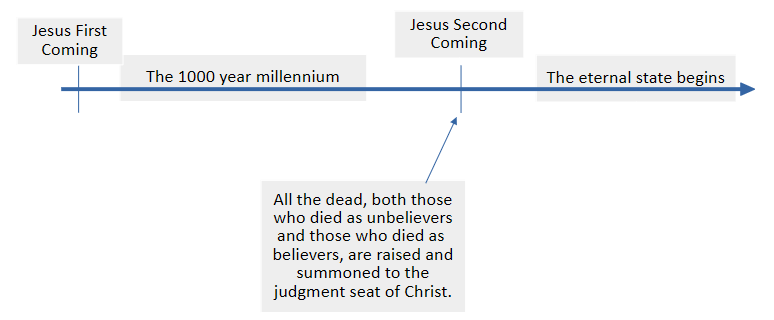
Start with the the premillennialists; what do they teach?
The premillennialists start with Revelation 20:
Then I saw an angel coming down from heaven, holding the key of the abyss and a great chain in his hand. And he laid hold of the dragon, the serpent of old, who is the devil and Satan, and bound him for a thousand years; and he threw him into the abyss, and shut it and sealed it over him, so that he would not deceive the nations any longer, until the thousand years were completed; after these things he must be released for a short time. Then I saw thrones, and they sat on them, and judgment was given to them. And I saw the souls of those who had been beheaded because of their testimony of Jesus and because of the word of God, and those who had not worshiped the beast or his image, and had not received the mark on their forehead and on their hand; and they came to life and reigned with Christ for a thousand years. The rest of the dead did not come to life until the thousand years were completed. This is the first resurrection. Blessed and holy is the one who has a part in the first resurrection; over these the second death has no power, but they will be priests of God and of Christ and will reign with Him for a thousand years. (Revelation 20:1-6)
Since mention is made here of a first resurrection, they assume that there is also a second.
- They understand the first resurrection to be the resurrection of all the righteous dead. This takes place before the millennium.
- The second resurrection is the resurrection of all the wicked dead and takes place after the millennium.
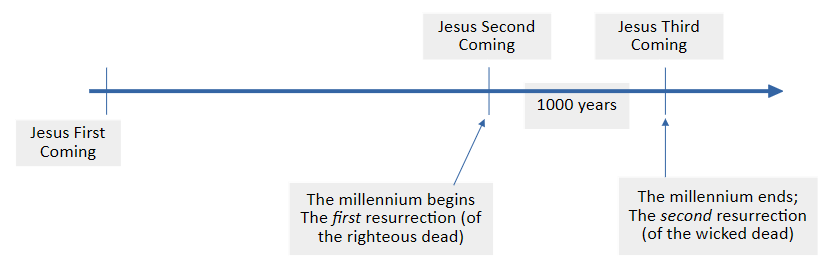
Is there any other Scripture that supports this teaching?
The only explicit teaching that a millennium separates the resurrection of the righteousness from the resurrection of the wicked is in Revelation 20. Some premillennialists would point to Paul’s teaching in 1 Corinthians 15.
Start with Revelation 20. What can be said about the premillennial reading of this text?
Because premillennialists understand all the righteous dead to have been raised at the beginning of the millennium, they must understand the resurrection and judgment, spoken of in Revelation 20:11-15, to be the resurrection and judgment of only the wicked dead. Revelation 20:11-15, however, does not read this way as was stated above. The judgment here is the final judgment of all persons.
What does John mean then, by the first resurrection?
This was also explained above. The first resurrection is a reference to those Christians who die before Christ returns and are given new life in heaven where they live and reign with Christ for the duration of the millennium or what is often called the intermediate state.
What other texts pertain to this question?
First, Jesus says the judgment of the righteous and the wicked is in the same hour:
Do not marvel at this; for an hour is coming, in which all who are in the tombs will hear His voice, and will come forth; those who did the good deeds to a resurrection of life, those who committed the evil deeds to a resurrection of judgment. (John 5:28-29)
The prophet Daniel implies the same thing:
Now at that time Michael, the great prince who stands guard over the sons of your people, will arise. And there will be a time of distress such as never occurred since there was a nation until that time; and at that time your people, everyone who is found written in the book, will be rescued. Many of those who sleep in the dust of the ground will awake, these to everlasting life, but the others to disgrace and everlasting contempt. Those who have insight will shine brightly like the brightness of the expanse of heaven, and those who lead the many to righteousness, like the stars forever and ever. (Daniel 12:1-3)
How are we to understand Paul’s teaching in 1 Corinthians 15?
Here Paul writes:
For as in Adam all die, so also in Christ all will be made alive. But each in his own order: Christ the first fruits, after that those who are Christ’s at His coming, then comes the end, when He hands over the kingdom to the God and Father, when He has abolished all rule and all authority and power. (1 Corinthians 15:22-24)
The order given is:
- Jesus’ resurrection;
- The resurrection of those who are Christ’s at His coming;
- The final and complete destruction of all opposition (abolishing all rule, authority, and power) which implies the resurrection and eternal punishment of the wicked.
The premillennialists would say that #2 is before the 1000 year millennium and #3 is after the millennium.
Is it likely that there will be such a gap between the resurrection of the righteous and that of the wicked?
Premillennialists point out that there is a large gap between Jesus’ resurrection and the resurrection of the righteous. Why can there not be a similar gap between the resurrection of the righteous and the wicked?
Why does this text not support the premillennialist?
Because of two doctrines that Jesus gave us both which pertain to “the last day” and teach us how to understand Paul’s teaching in 1 Corinthians 15:23. First, Jesus teaches us that the resurrection will happen on the “last day:”
- 39 This is the will of Him who sent Me, that of all that He has given Me I lose nothing, but raise it up on the last day.
- 40 “For this is the will of My Father, that everyone who beholds the Son and believes in Him will have eternal life, and I Myself will raise him up on the last day.
- 44 No one can come to Me unless the Father who sent Me draws him; and I will raise him up on the last day.
- 54 He who eats My flesh and drinks My blood has eternal life, and I will raise him up on the last day. (John 6:39-40, 44, 54; 11:24)
- Martha said to Him, “I know that he will rise again in the resurrection on the last day.” (John 11:24)
Second, He teaches us that the last judgment will also take place on the “last day:”
I have come as Light into the world, so that everyone who believes in Me will not remain in darkness. If anyone hears My sayings and does not keep them, I do not judge him; for I did not come to judge the world, but to save the world. He who rejects Me and does not receive My sayings, has one who judges him; the word I spoke is what will judge him at the last day. (John 12:46-48)
But the premillennial teaching is that the last judgment takes place after the millennium and the resurrection of the righteous takes place before the millennium. But Jesus places both these events on “the last day.” It is hard to read the premillennial timeline into the expression “last day.”
How do the amillennialists understand the timing of the resurrection?
Amillennialists believe in one resurrection of all people at the end of time.
The Resurrection Body
What are the characteristics of the body God will give each person on the day of our resurrection?
Paul writes of this in 1 Corinthians 15:
So also is the resurrection of the dead. It is sown a perishable body, it is raised an imperishable body; it is sown in dishonor, it is raised in glory; it is sown in weakness, it is raised in power; it is sown a natural body, it is raised a spiritual body. If there is a natural body, there is also a spiritual body. (1 Corinthians 15:42-44)
From this, we conclude that our resurrection body will have these four characteristics:
- imperishable,
- glorious,
- powerful,
- spiritual.
What is meant by an imperishable body?
This refers to a body which is not subject to weakness, decay, and eventually death.
What is meant by glorious?
This is more difficult to explain exactly. Evidently, Paul teaches us here that our resurrection body will shine with a certain luster and beauty that our current bodies do not.
What is meant by powerful?
Here too, we must assume that our resurrection body will be capable of things which currently, we are not able to do. Grotius says (p446) that we will have many senses that we do not now comprehend.
What is meant by spiritual?
We must be careful not to think that spiritual here means without a physical body. In this context, spiritual means controlled and animated by the Holy Spirit. Peter refers to this as the divine nature. (2 Peter 1:4)